
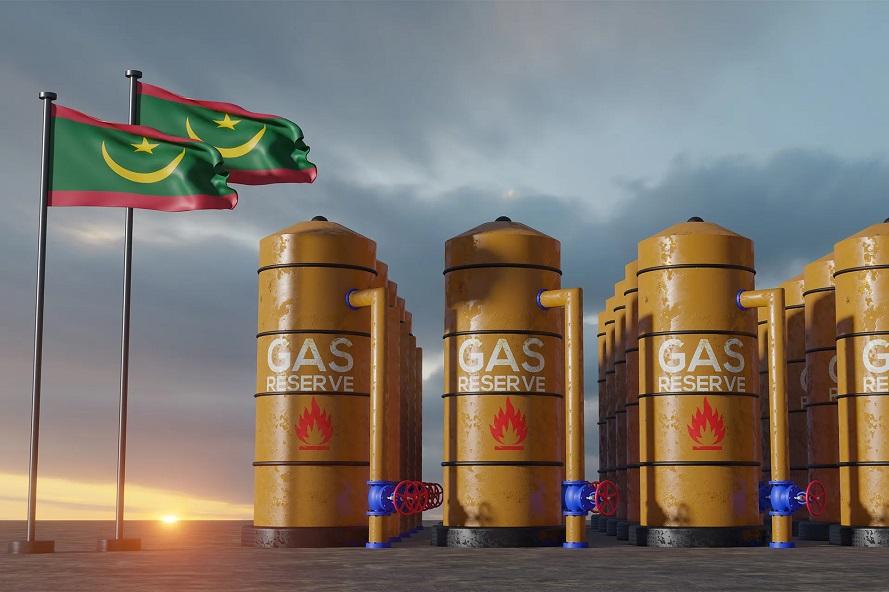
Mauritania is making significant strides towards becoming a regional player in the natural gas market through large-scale projects that are laying the foundation for a new era in the country’s energy history. Thanks to major gas discoveries over the past two decades, the country is working on developing these vast resources through effective partnerships and multi-phase development strategies aimed at supporting energy security, boosting economic development, and contributing to the transition to clean energy.
Grand Turtle Ahmeyim Field (GTA)
The GTA field, one of the most significant gas projects in West Africa, lies on the maritime border between Mauritania and Senegal, at a depth of approximately 2,800 meters below sea level. The reserves of this field range between 25 and 50 trillion cubic feet of gas, equally divided between the two countries, making it a truly regional project.
The Mauritanian Petroleum Company, in cooperation with BP, Kosmos Energy, and Petrosen, is developing this field, reflecting international confidence in Mauritania’s investment environment and the country’s economic potential.
The project is being implemented in successive phases to ensure optimal resource utilization and the sustainability of production in the long term.
Phase 1: Actual Start of Production (2025)
This phase began in early 2025, encompassing the development of production, transport, and liquefaction infrastructure. It is expected that annual production will reach 2.5 million tons of liquefied natural gas (LNG), along with a daily production of around 6,000 barrels of condensates. This achievement marks Mauritania’s real entry into the global gas market.
Phases 2 and 3: Expanding Production and Building Capacity
The next phases aim to raise production capacity to 10 million tons per year, which will double the project’s contribution to the national GDP and enhance Mauritania’s attractiveness as an energy hub in Africa. Technical and strategic studies have already been launched to identify the best development pathways and expand storage and transportation capacities while considering environmental sustainability.
Bir Allah Field: Massive Reserves and Future Development Strategy
The Bir Allah field was discovered in 2015, located entirely within Mauritania’s territorial waters at a depth similar to that of the GTA field, around 2,800 meters, and approximately 40 kilometers north of it. This field is considered one of the largest untapped gas discoveries in West Africa, with estimated reserves of around 80 trillion cubic feet of gas.
As the field is fully within Mauritania’s territorial waters, the country has complete control over its development, aligning the production with its energy and economic priorities. Plans for technical and institutional preparations to launch development operations are currently underway, with major international companies showing interest in this strategic project.
The Bir Allah field is expected to play a pivotal role in achieving gas self-sufficiency, supplying national industrial projects with clean energy, and offering huge export potential through advanced offshore liquefaction facilities.
Banda Gas Field: A Comprehensive Model for Energy Security and Industrial Transformation
The Banda field represents a qualitative project in the development of Mauritania’s energy infrastructure. Located 70 km off the coast of Nouakchott, at depths ranging from 200 to 350 meters, it contains exploitable reserves estimated between 1.2 and 2 trillion cubic feet of gas.
A New Development Contract and Promising Regional Partnership
In March 2024, the Mauritanian government signed an exploration and production contract with the Taqa Arabia and Go Gas Holding consortium, aiming to develop the field within a three-phase vision. This agreement is part of the broader strategy to integrate gas into the local economic cycle rather than solely exporting it.
Phase 1 (Until 2027): Transport Infrastructure
This phase includes the construction of a 75 km subsea pipeline to transport gas from the field site to land, marking the first step toward industrial energy exploitation and connecting it to conversion and consumption stations.
Phase 2: Energy Conversion and Capacity Expansion
The existing dual-fuel power station in Nouakchott (180 MW) will be converted to a gas-powered system, contributing to reduced emissions and lower operating costs. A new power plant with a capacity ranging from 120 to 240 MW will also be built to meet the growing electricity demand, particularly in the industrial sector.
Phase 3: Development of Gas-Based Industries
This phase includes establishing units to convert gas into liquid fuels (GTL) and compressed natural gas (CNG), enabling its use in the transportation sector and reducing dependence on imported fuels. This transition supports environmental sustainability and opens new prospects for localizing the energy industry.
Towards Energy Independence and Sustainable Industrial Growth
Mauritania’s major gas projects, including GTA, Bir Allah, and Banda, form the cornerstone of a comprehensive plan aimed at transforming the country into a regional energy platform. These projects reflect Mauritania’s aspirations to achieve energy security, diversify sources of income, and attract direct foreign investment in a promising sector with long-term potential.